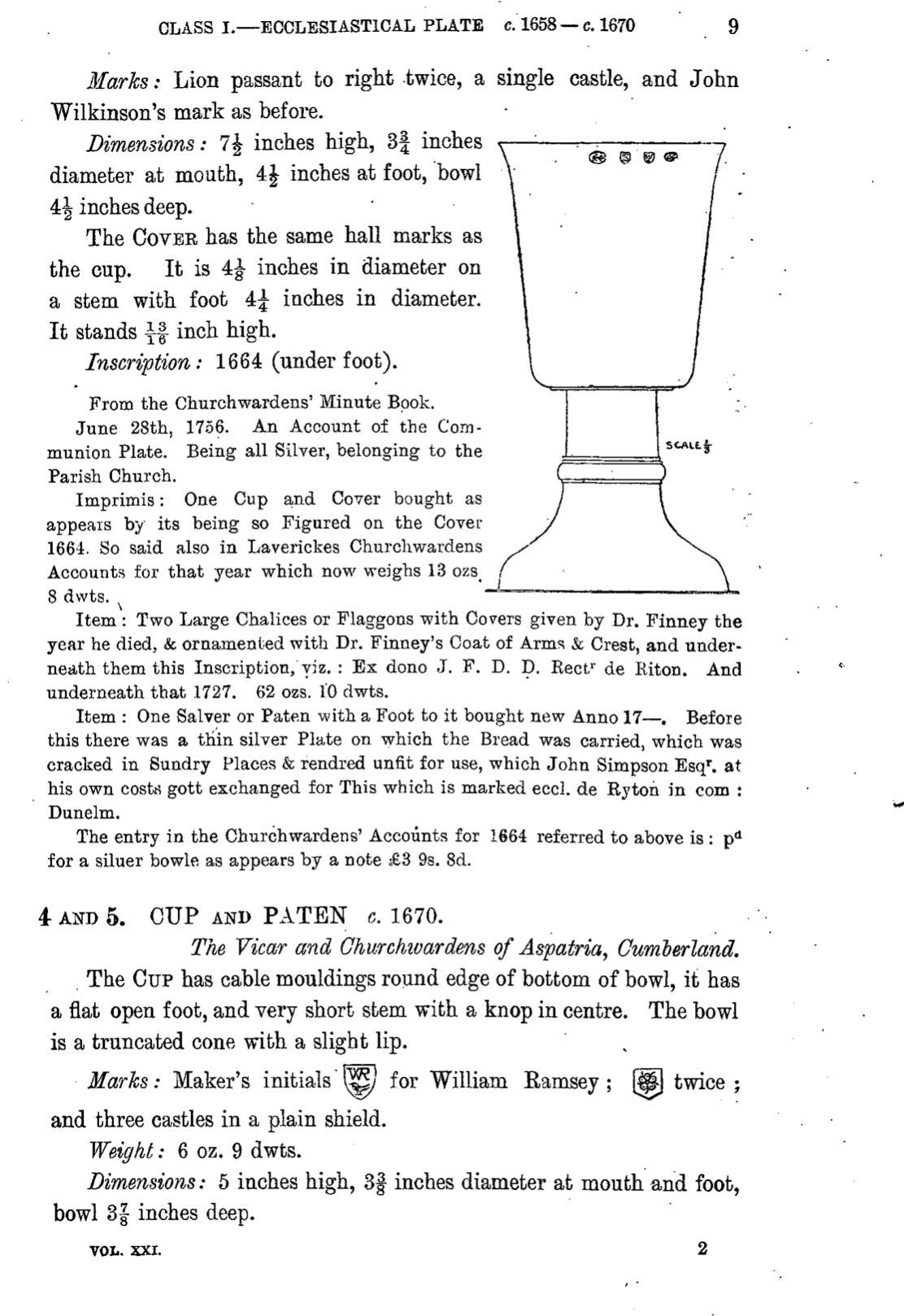
The earliest piece, bearing the inscribed date of 1664, is a communion cup from Ryton, Co. Durham, made by John Wilkinson. From Trimdon, in the same county, there is a wine glass shaped cup, which appears to be quite as old as that at Ryton, or possibly a little older, but as it was also made by John Wilkinson, who was admitted to his freedom in 1658, it cannot be of earlier date than that year.
The best known worker of that period was William Ramsey, who was admitted to his freedom in 1656 and died in 1698. The earliest piece of ‘his make having an inscribed date is a flagon from Sawley near Ripon, which bears date 1670. Good examples of his work come from Rose castle and other places. Other makers represented are John Dowthwayte, who made the flagons at St. Mary’s, Gateshead, about 1672, and Eli Bilton whose mark is found on the Chollerton cup dated 1687.
Two very fine flagons from All Saints, Newcastle, bear the mark of Thomas Hewitson; one of these at least must have been made during the period in which no plate could legally be assayed, as they are dated 1697 and 1698. Of ‘Britannia standard,’ good specimens come from Durham St. Mary-the-less, Stanhope, Castle Eden, Sherburn hospital, and other places. From 1721, when the old standard of plate was restored, down to the end of the century, a large quantity of church plate was assayed at Newcastle, and numerous specimens are exhibited, the principal makers being Isaac Cookson and John Langlands.